Signalwise Picks
Browse
Wired networking

2.5GbE vs 10GbE Switch: Which Upgrade Makes Sense?

Current retailer option

TP-Link TL-SX105, 5 Port 10G/Multi-Gig Unmanaged Ethernet Switch | Desktop/Wall Mount, Plug & Play, Fanless, Sturdy Metal Casing, Speed Auto Negotiation

Check current price & availability on Amazon

Current price & availability ยท purchase link

Open the exact family listing to compare the live price, availability, delivery, seller, and returns.

Compare 2.5GbE and 10GbE around actual file transfers, NAS links, client ports, cabling, heat, noise and the total upgrade path.

Prepared by the Signalwise Picks editorial deskUpdated September 4, 2026

Quick answer

The practical answer

Choose 2.5GbE when internet access and ordinary client traffic are the main bottlenecks and existing Cat5e runs must stay. Choose 10GbE when repeated local transfers, editing or backups can sustain more than 2.5Gbps end to end and the NAS, clients, cabling and cooling are ready. A single 10GbE uplink with 2.5GbE access ports is often the lower-cost middle path.

Common buying question

Should a home or small office buy a 2.5GbE or 10GbE switch?

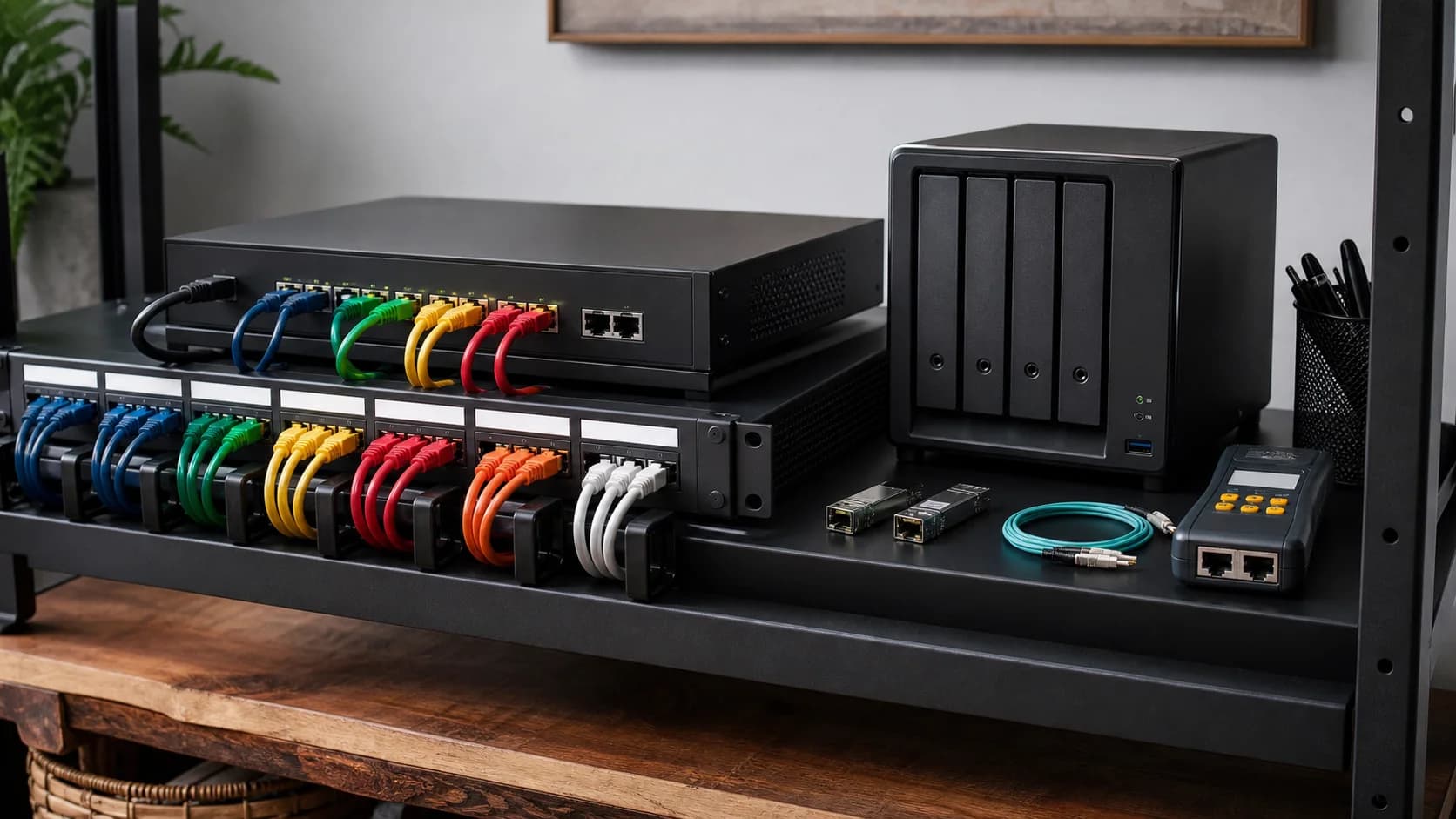
Original editorial scene with unbranded Ethernet switching, cabling, storage, and test equipment
Original editorial image for category, fit, and use context; verify the exact linked product appearance and configuration on the retailer page.

Prove an end-to-end workload before paying for every 10GbE port

Measure one repeated transfer between the actual storage and client, then list the slowest interface, disk or cable on that path. A 10GbE switch cannot overcome a 1GbE client, slow storage or an internet-only workload. Price network cards, transceivers, cables, power and acoustic placement with the switch. If only the NAS uplink is constrained, a mixed-speed switch can solve the bottleneck without converting every endpoint.

The real fork is specialized function versus 2.5gbe switch

10GbE switch win when they can connect a small set of 10GbE devices without forcing the entire network to upgrade and that function removes a known recurring problem. 2.5GbE switch win when they reach the same outcome with fewer dependencies, less maintenance, a more understandable failure mode, or a cleaner return path.

Normalize number and type of 10GbE ports and RJ45 heat versus SFP+ optics or DAC

Compare both paths across the same topology, client mix, cable path, traffic load, and recovery window, with every required dependency included. A complete 10gbe switch package should not be compared with an incomplete alternative, and a retailer headline should not replace product-level compatibility evidence.

Use switching capacity and fan noise and 2.5GbE and 1GbE fallback support as tie-breakers

In a 10gbe switch comparison, switching capacity and fan noise and 2.5GbE and 1GbE fallback support reveal the friction that appears after an attractive demo. Choose the path that can be installed, used, cleaned, updated, and recovered by the people who will actually own it. Prefer the simpler failure mode when performance is otherwise close.

Compare ownership, not only purchase price

10GbE switch bring an ownership path of power draw, fan replacement or noise, hot transceivers, cabling, and the cost of 10GbE interfaces for every endpoint. Price that against the maintenance and replacement work of 2.5gbe switch over one normal year. Include the value of time and the cost of losing the service while a proprietary part, account, or repair is unavailable.

Make the choice reversible

Use this test path before the return window closes: draw each 10GbE endpoint and cable length, choose media per link, update firmware, and verify negotiated speed one port at a time. Preserve the old setup and packaging until the product survives normal use. Choose the alternative immediately when only internet speed is being upgraded, the NAS or workstation cannot sustain 10Gbps, or a fanless 2.5GbE switch removes the real bottleneck.

Current Amazon option

Check this exact product

TP-Link TL-SX105, 5 Port 10G/Multi-Gig Unmanaged Ethernet Switch | Desktop/Wall Mount, Plug & Play, Fanless, Sturdy Metal Casing, Speed Auto Negotiation

ASIN
B09CYNHL4S
Brand
TP-Link
Listing checked
8/9/2026

Compare the current title, ASIN, variant, seller, stock, shipping, price, and return path before ordering.

Side-by-side checks

10GbE switch vs. 2.5GbE switch: the decision table

Check10GbE switch2.5GbE switch
Useful workloadLarge local transfers, multi-user NAS traffic, editing and fast backups.Internet access, Wi-Fi uplinks and general client traffic.
InfrastructureNeeds compatible NICs, storage, cabling or optics and more thermal planning.Often reuses Cat5e and lower-power client hardware.
OwnershipHigher port, adapter, power, heat and sometimes noise cost.Lower-cost, cooler and easier to deploy broadly.
Middle pathUse 10GbE only for servers or uplinks where measured traffic justifies it.Use 2.5GbE at access ports until more endpoints exceed it.
Decision proofRecord why 10gbe switch solves the repeated job under real conditions.Record why 2.5gbe switch solves the same job with a clearer fit or ownership path.
Recheck pointRecheck the choice after normal use, maintenance, and one recoverable failure of 10gbe switch.Keep 2.5gbe switch available until the new path passes that test.

Primary sources

References used for this guide

Public owner context

Questions to answer before buying

Community discussions help surface installation, fit, maintenance, and failure questions. They are anecdotal context, not product specifications or a substitute for current instructions.

  • Reddit community discussion

    Recommendations for Inexpensive 10GbE switches

    A public owner discussion used to identify questions and failure modes. Comments are anecdotal; no username, vote count, rating, or verbatim review is reproduced, and product facts must be verified independently.

Research notes

How we evaluated these choices

  1. 1.Answer the exact A-versus-B decision before broader fit, ownership, and workflow guidance.
  2. 2.Define one independent purchase or use question for this URL.
  3. 3.Verify the four family-specific dimensions: number and type of 10GbE ports; RJ45 heat versus SFP+ optics or DAC; switching capacity and fan noise; 2.5GbE and 1GbE fallback support.
  4. 4.Use an exact Amazon ASIN only as a current retailer identity and checkout anchor, not as hands-on evidence.
  5. 5.Separate public community discussion from official specifications and editorial judgment.
  6. 6.Keep a written stop condition and a reversible test path.

Related guide

10GbE Switches Buying Guide

Which 10gbe switches are worth buying when the real job is to connect a small set of 10GbE devices without forcing the entire network to upgrade? This guide turns that question into model-level checks, a reversible setup, a first-year ownership plan, and a clear skip decision.

Related guide

10GbE Switches: Compatibility and Fit Guide

Will 10gbe switches fit the exact user, space, equipment, and installation path? This guide turns that question into model-level checks, a reversible setup, a first-year ownership plan, and a clear skip decision.

Related guide

10GbE Switches: Ownership Cost and Maintenance

What will 10gbe switches cost and require after checkout? This guide turns that question into model-level checks, a reversible setup, a first-year ownership plan, and a clear skip decision.

Related guide

Wireless Bridge vs Ethernet: Which Link Should You Build?

Compare a wireless bridge with buried Ethernet or fiber by line of sight, trenching cost, real throughput, weather exposure, maintenance and outage recovery.

Related guide

PCIe Ethernet Card vs USB Adapter: Which Is Better?

Compare PCIe and USB Ethernet by computer access, bus bandwidth, port speed, driver support, heat, sleep behavior, portability and whether the connection must run continuously.

Related guide

SFP+ DAC vs Fiber Transceivers: Which Link Is Better?

Choose a short SFP+ DAC link or an optical link by checking both devices' support lists, cable type and length, routing, and the cost of the complete connection.

Related guide

Cat6 vs Cat6A vs Flat Ethernet Cable: What to Buy for Home

Choose Cat6, Cat6A, flat cable, or short patch cables by run length, placement, speed target, and damage risk.

Related guide

Home Ethernet Switch Buying Guide: Gigabit, 2.5G and Smart Features

Pick a home Ethernet switch by port count, speed, fanless operation, VLAN needs, desk placement, and room to grow.