Name the job before buying the tool
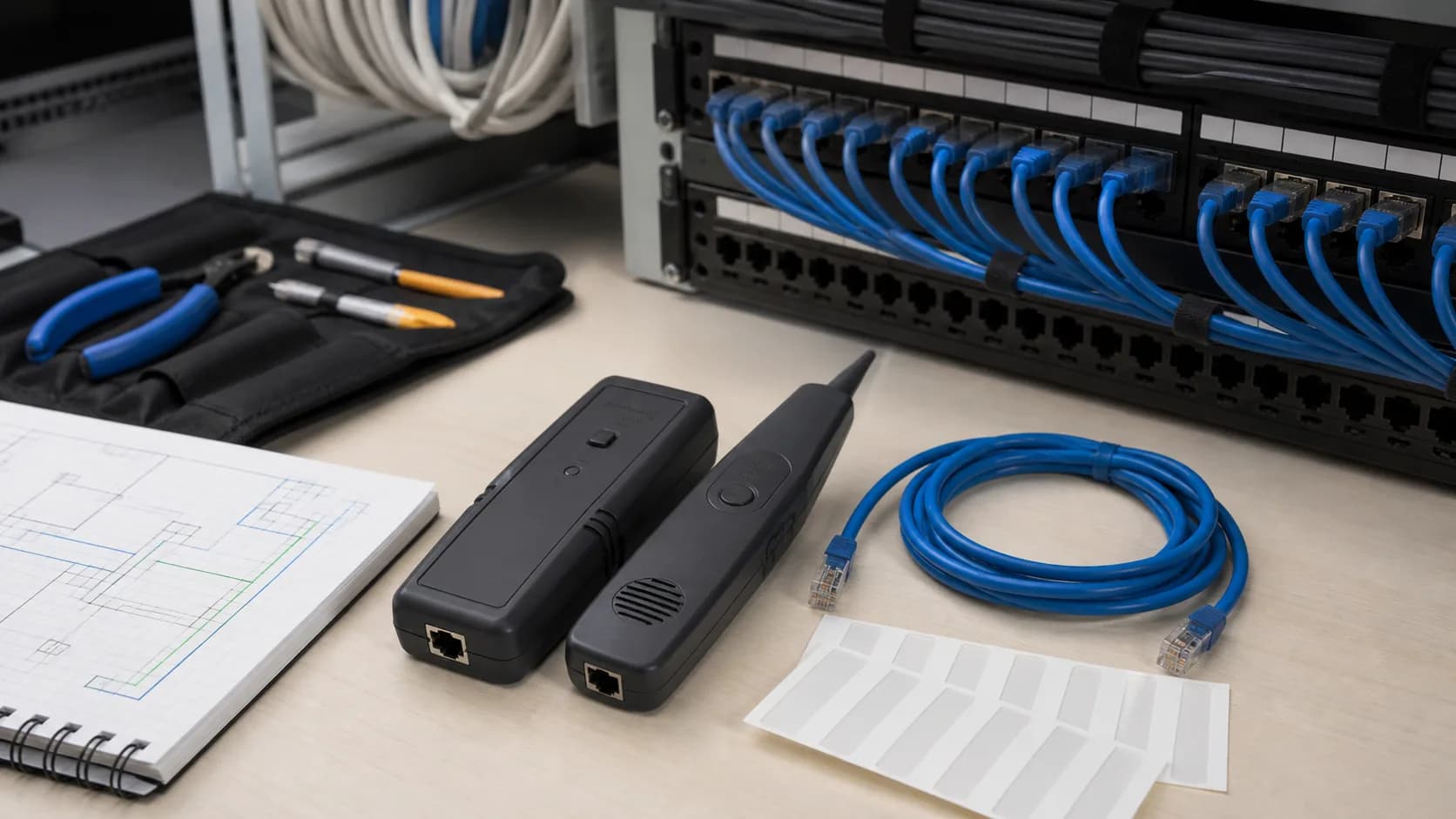
Use a toner and inductive probe to find a cable whose far end is unknown. Use a wiremap tester to identify opens, shorts, reversals, and split pairs when both ends are accessible. Qualification and certification are different, more demanding tasks. One kit can combine basic functions, but its product name does not make those functions equivalent.
Disconnect and inspect before injecting tone
Identify power, PoE, telephone voltage, active switches, and connected equipment. Follow the exact manual on whether a given mode can touch a live circuit. Label both ends and isolate the run whenever possible. Never assume an RJ45-shaped port is ordinary unpowered Ethernet or connect an unknown cable just to see what happens.
Match the tone to the building
Crowded bundles, foil, conduit, long parallel runs, and electrical noise change how clearly a probe can distinguish one cable. Compare tone patterns, sensitivity control, audible and visual indication, probe tip access, headphone support, and replaceable parts. Practice on a labeled run before entering a dense cabinet.
Use a repeatable trace-and-label workflow
Start at a documented outlet, photograph the panel, tone only the isolated run, reduce sensitivity as the candidate narrows, confirm with continuity or a remote identifier, then label both ends with the same permanent identifier. Update the port map immediately; otherwise the tool solves the same uncertainty again on the next visit.
Know when the kit is not enough
A basic toner does not prove Cat6A performance, locate every intermittent fault, authorize work on energized conductors, or replace a network qualification report. Use a switch-port tool for active endpoint discovery and a proper certifier or qualified cabling professional when the result must support a warranty, building handoff, or compliance record.