Open the exact family listing to compare the live price, availability, delivery, seller, and returns.
Choose a rack PDU by circuit capacity, plug and outlet layout, protection role, mounting direction, cord reach, and the UPS or wall circuit feeding it.
Prepared by the Signalwise Picks editorial deskUpdated August 10, 2026
Quick answer
The practical answer
Use a listed rack PDU to distribute one correctly sized circuit across reachable outlets; do not assume it supplies battery backup or surge protection. Map plug types, continuous load, mounting position, cord path, and the upstream UPS before choosing outlet count.
Common buying question
What rackmount PDU should I use for a home network rack, and does it replace a UPS or surge protector?
Existing UPS content focuses on runtime and modem/router continuity rather than rack outlet orientation, input plug, branch-circuit load, and PDU protection class.
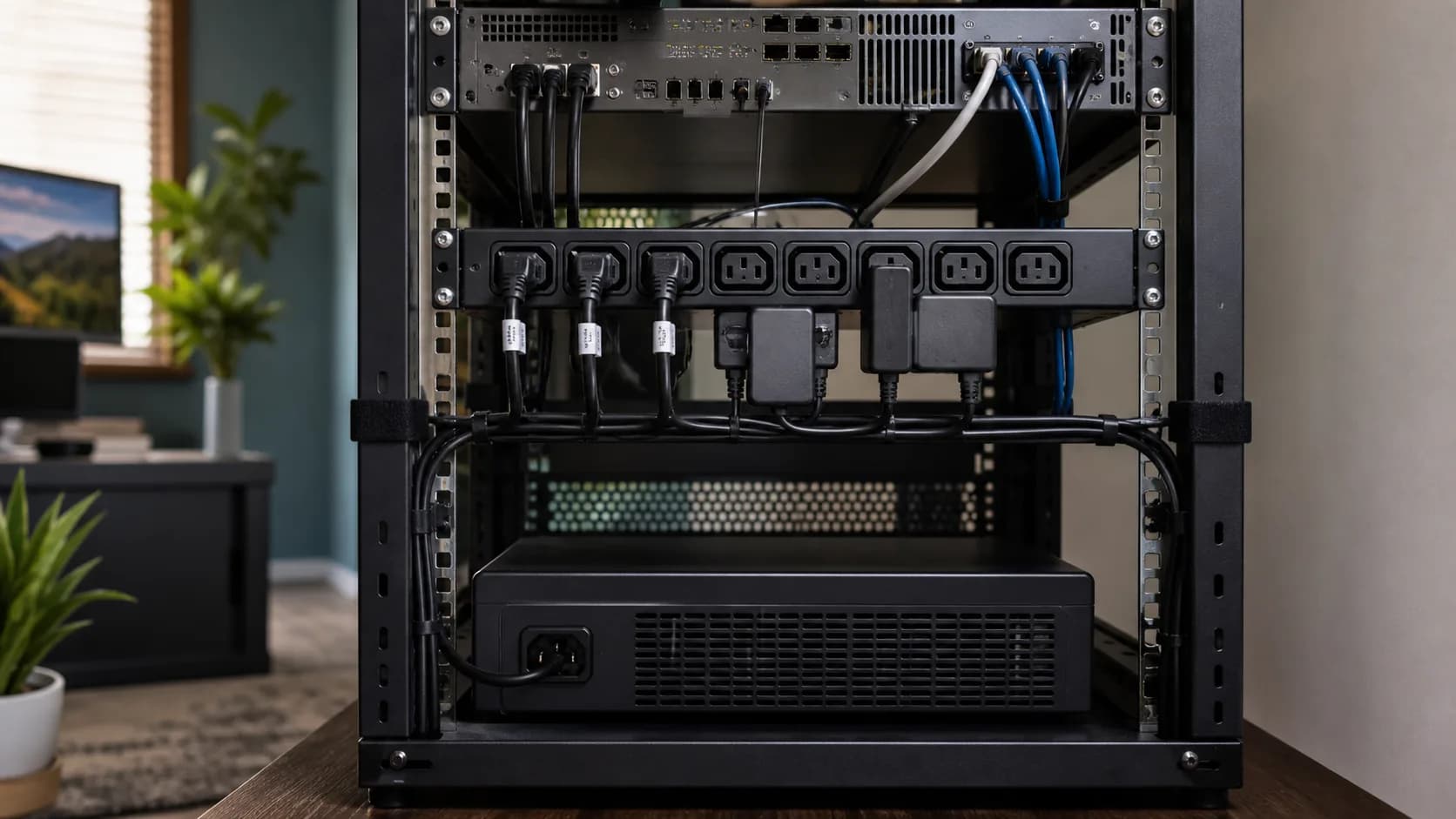
Original editorial image for category, fit, and use context; verify the exact linked product appearance and configuration on the retailer page.
Decide what the PDU is supposed to do
A basic PDU distributes power. Some models add surge suppression, local metering, remote outlet switching, or environmental monitoring, while a UPS adds battery-backed power and voltage behavior of its own. Write the required job first so a row of outlets is not mistaken for protection the model never claims.
Calculate the whole upstream load
Record the wall circuit, receptacle, input plug, UPS output limit if used, PDU rating, and every connected device. Allow for continuous-load guidance, startup behavior, and future equipment. Do not daisy-chain power strips or use plug adapters to make an incompatible layout appear to fit; follow the current electrical code and product instructions.
Model power bricks in three dimensions
Outlet count is misleading when wide adapters cover neighbors or cable exits collide with the rack door. Lay out each plug, brick, and service loop at scale. Rear-facing outlets can clean up the front but must remain reachable for labeling, inspection, and emergency disconnection.
Mount without creating heat or cable strain
Confirm 1U or vertical compatibility, rack depth, bracket orientation, cord reach, ventilation, and bend radius. Keep low-voltage data cabling organized separately from mains power where practical. The breaker, power switch, and upstream disconnect should remain visible and documented after the rack is populated.
When an ordinary strip or UPS outlet group is enough
Skip a rack PDU when there are only a few low-power devices outside a rack and a correctly rated, listed surge protector reaches them safely. Use UPS outlets directly when the unit's layout, load rating, and supported connection policy already fit. A PDU is valuable for distribution and serviceability, not because rack mounting makes electricity safer by itself.
Current Amazon option
Check this exact product
CyberPower CPS1215RMS 1U Rackmount Surge Protector with 12 Outlets and 15-Foot Cord
ASIN
B00077INZU
Brand
CyberPower
Listing checked
8/10/2026
Compare the current title, ASIN, variant, seller, stock, shipping, price, and return path before ordering.
Exact draft anchor listing; recheck seller, model, and live availability before publication.
Public owner context
Questions to answer before buying
Community discussions help surface installation, fit, maintenance, and failure questions. They are anecdotal context, not product specifications or a substitute for current instructions.
Used to surface practical questions about rear mounting, wall plugs, UPS chaining, and adapter clearance; anecdotes are not treated as electrical approval.
How this page was governed
Page-specific editorial method
1.Map the upstream circuit, UPS, PDU, and every attached load as one electrical path.
2.Use manufacturer nameplate values and an electrician where branch-circuit suitability is uncertain.
3.Classify protection features explicitly instead of treating every rack power strip as equivalent.
4.Verify listing identity and included mounting hardware again at publication time.