Open the exact family listing to compare the live price, availability, delivery, seller, and returns.
Choose a pass-through RJ45 crimper by connector system, cable construction, conductor gauge, shield support, ratchet behavior, trim quality, replacement blades, and the tester used after termination.
Prepared by the Signalwise Picks editorial deskUpdated August 10, 2026
Quick answer
The practical answer
Buy the crimper and modular plugs as a verified system. Pass-through describes conductors extending beyond the plug for visual ordering and flush trimming; it does not guarantee compatibility across brands, gauges, solid or stranded cable, shielding, or large-diameter Cat6A. Permanent in-wall cable is often better terminated on jacks or patch panels.
Common buying question
Should I buy a pass-through Ethernet crimper, and will it work with any Cat6 or Cat6A RJ45 plug?
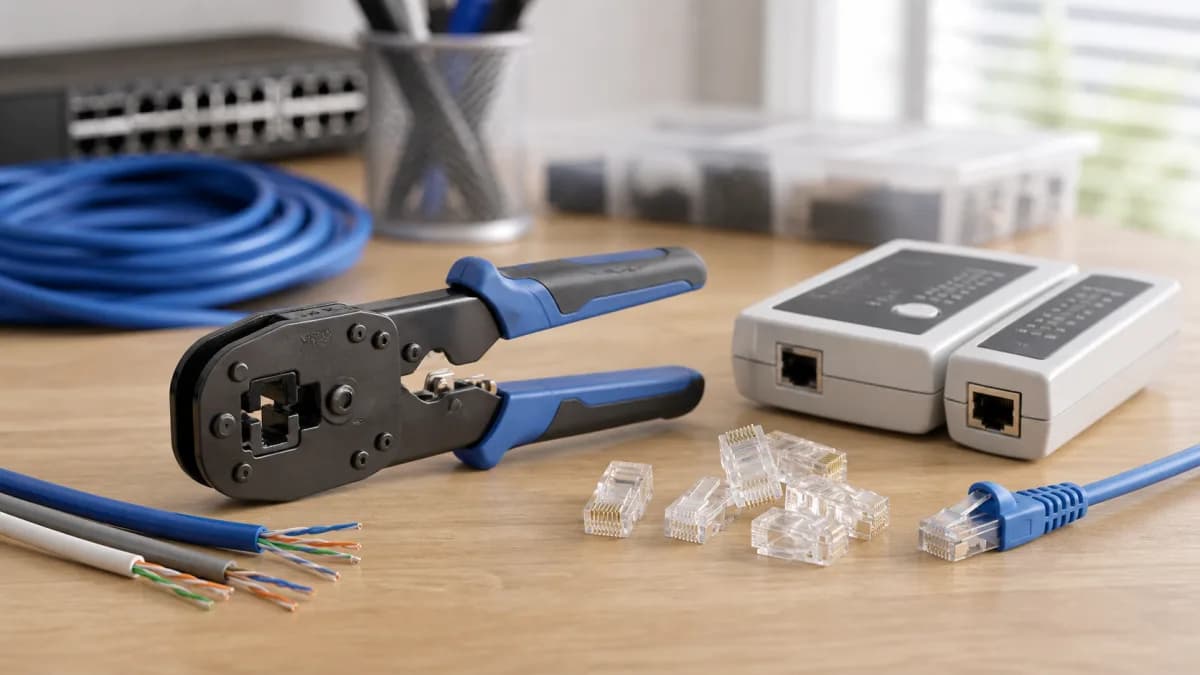
Original editorial image for category, fit, and use context; verify the exact linked product appearance and configuration on the retailer page.
Treat plugs and crimper as one termination system
Start with the exact cable: solid or stranded, conductor gauge, overall diameter, shielding, and pair separator. Then choose a modular plug designed for it and a crimper the plug manufacturer supports. The words Cat6 and pass-through do not establish compatibility. A tool can close a connector mechanically while the contacts, jacket clamp, or trim remain wrong.
Understand what pass-through changes
With a pass-through plug, conductors extend through the nose so order and reach can be inspected before crimping. The tool then seats contacts, captures the jacket, and cuts the protruding conductors. This can make occasional terminations easier, but it adds a blade-dependent cut at the plug face. Inspect every cut for copper stubs or a damaged connector body.
Do not make every cable in the network
Factory patch cords have controlled assembly and are usually the better choice between equipment and wall ports. Use field plugs when route, repair, length, or device access makes them genuinely useful. For permanent in-wall horizontal cable, rated jacks and patch panels are easier to service and align with common structured-cabling practice than male plugs hidden at both ends.
Practice jacket capture and pair order
Strip only the instructed length, preserve twists, arrange conductors to one wiring scheme, and keep the cable jacket inside the plug's strain-relief area. Run a full ratchet cycle without twisting the connector. If the jacket sits outside the clamp, a conductor is nicked, or the flush cut is uneven, replace the plug instead of relying on a link light.
Finish with the right test
At minimum, wiremap every assembled cord and flex it gently while testing to expose intermittent contact. A simple tester does not prove Cat6 bandwidth. Use qualification or certification equipment when performance documentation matters, and label custom cables by endpoints and length. Replacing a suspect handmade cord is often faster than diagnosing it in a live network.
Current Amazon option
Check this exact product
Klein Tools VDV226-110 Ratcheting Modular Data Cable Crimper, Stripper and Cutter for RJ45 Pass-Thru Connectors
ASIN
B076MGPQZQ
Brand
Klein Tools
Listing checked
8/10/2026
Compare the current title, ASIN, variant, seller, stock, shipping, price, and return path before ordering.
Exact Klein Tools VDV226-110 anchor; verify style selection, seller, and availability immediately before publication.
Public owner context
Questions to answer before buying
Community discussions help surface installation, fit, maintenance, and failure questions. They are anecdotal context, not product specifications or a substitute for current instructions.
Used to identify practical confusion about matching connectors, tools, cable, and test equipment; no community recommendation overrides the tool and connector instructions.
Research notes
How we evaluated these choices
1.Choose the cable and exact modular connector first, then confirm the tool manufacturer supports that combination.
2.Practice on spare cable, inspect the jacket position and flush conductor face, and discard damaged plugs.
3.Use factory patch cords where practical and terminate permanent horizontal cable on rated jacks or panels.
4.Wiremap every field-made cord and escalate to qualification or certification when the project requires it.