Open the exact family listing to compare the live price, availability, delivery, seller, and returns.
Choose an Ethernet keystone by installed cable category, conductor construction and gauge, shielding, termination method, faceplate fit, and the test result required after punch-down.
Prepared by the Signalwise Picks editorial deskUpdated August 10, 2026
Quick answer
The practical answer
Match the jack to the lowest-rated permanent-link component, the cable's solid or stranded conductors, wire gauge, shielding, and the wall plate or patch-panel opening. For ordinary in-wall solid UTP, a listed punch-down jack with clear T568A/B markings is usually easier to inspect and replace than terminating a male plug on the permanent cable.
Common buying question
Which Ethernet keystone jack should I buy for existing Cat5e, Cat6, or Cat6A cable in a wall?
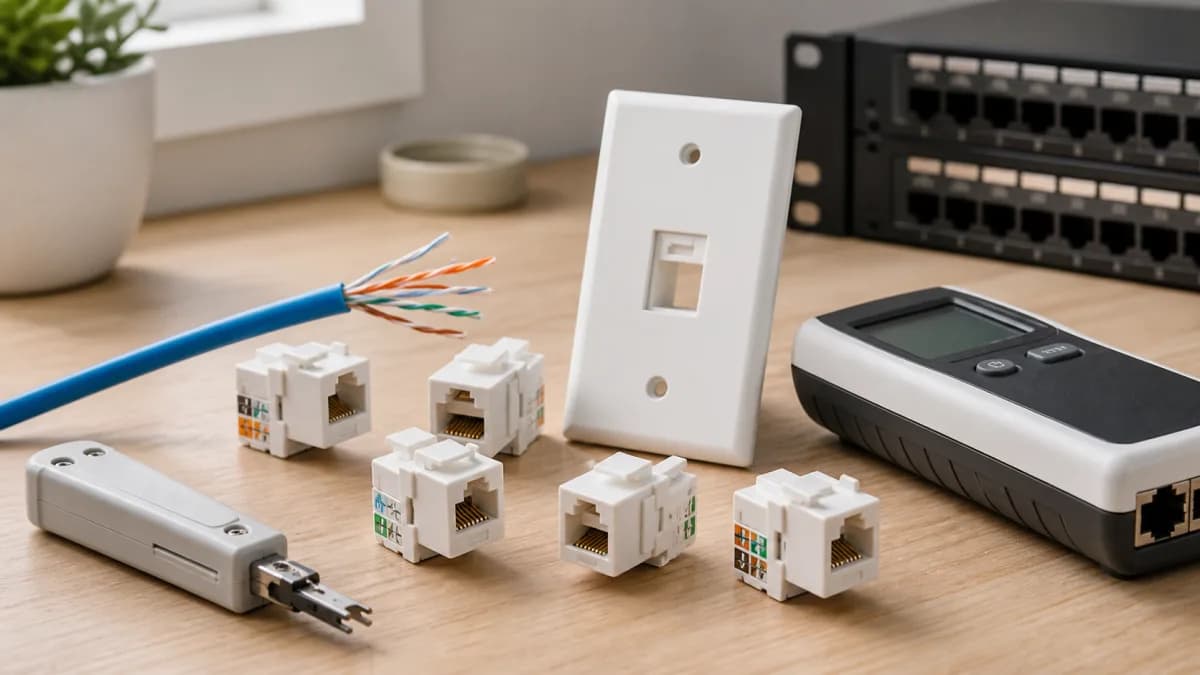
Original editorial image for category, fit, and use context; verify the exact linked product appearance and configuration on the retailer page.
Start with the cable already in the wall
Photograph the jacket printing at an accessible end. Record category, conductor material, solid or stranded construction, gauge, and shielding. The permanent link is only as capable as its least suitable component and installation. A Cat6-marked jack does not transform unknown cable into Cat6, and category claims should not replace inspection of every termination and patch lead.
Punch-down, tool-free, and coupler jacks solve different jobs
A 110-style punch-down jack is a conventional endpoint for solid horizontal cable and makes pair placement visible. Tool-free jacks can reduce tool requirements but still impose conductor and closing limits. Female-to-female couplers are useful for pre-terminated patch cable and serviceable extensions; they are not automatically the best permanent-wall termination merely because installation looks simpler.
Preserve pair geometry at the IDC
Choose T568A or T568B consistently at both ends, follow the jack's own color legend, and untwist only as much as the instructions require. Seat every conductor fully, trim cleanly, close the strain cap, and avoid crushing the cable with staples or tight bends. Reworking a marginal termination is cheaper than hiding it behind a finished wall plate.
Plan the plate and box in three dimensions
Confirm the jack actually snaps into the intended keystone opening and leaves room for neighboring modules. Deep rear bodies, cable exits, service loops, and bend radius can collide with a shallow low-voltage bracket or back box. Dense multi-port plates also need labels that remain readable after furniture and patch cords are installed.
Test the link at the level the project needs
A wiremap test can find opens, shorts, reversals, and some split pairs, but it does not certify category bandwidth. Qualification or certification may be appropriate for longer, higher-speed, warranty, or handoff work. Save the result with the room and port label. If the job requires documented performance, use the correct instrument or a qualified cabling professional.
Current Amazon option
Check this exact product
Cable Matters 25-Pack Cat6 RJ45 Keystone Jacks with Punch-Down Stand
ASIN
B004D5PFGW
Brand
Cable Matters
Listing checked
8/10/2026
Compare the current title, ASIN, variant, seller, stock, shipping, price, and return path before ordering.
Community discussions help surface installation, fit, maintenance, and failure questions. They are anecdotal context, not product specifications or a substitute for current instructions.
Used to identify recurring buyer confusion about Cat6 cable, keystone category, punch-down tools, and whole-link testing; no comment is treated as standards evidence.
Research notes
How we evaluated these choices
1.Read the printing on the installed cable and record conductor, gauge, category, and shielding before shopping.
2.Verify the exact jack datasheet rather than assuming every RJ45 keystone accepts every twisted-pair cable.
3.Keep pair twists close to the IDC, use one wiring scheme at both ends, and preserve bend radius and strain relief.
4.Test and label the completed permanent link; treat the Amazon ASIN only as a current checkout identity.